
HR Data Retention Schedule: Best Practices for UAE Employers
Many UAE employers keep HR records for years without a clear reason. Employee files, CVs, passport copies, payroll records, medical certificates, CCTV footage, and disciplinary documents often remain stored in HR systems, shared drives, email folders, and paper archives long after they are needed.
From a data protection perspective, this creates unnecessary risk.
A well-designed HR Data Retention Schedule helps employers decide how long different categories of employee data should be kept, when they should be deleted, and who is responsible for managing the process.
For companies operating under the UAE PDPL, DIFC Data Protection Law, ADGM Data Protection Regulations, or international privacy standards such as the GDPR, retention management is not just an administrative task. It is a core part of privacy compliance.
What Is an HR Data Retention Schedule?
An HR Data Retention Schedule is a document that defines how long different types of HR records should be retained. It usually includes:
In simple terms, it answers one practical question: “How long do we actually need to keep this employee data?”
Why HR Data Retention Matters
HR departments process some of the most sensitive information in any organization. This may include:
Keeping this data longer than necessary increases the risk of:
A retention schedule reduces these risks by ensuring that personal data is not kept “just in case” forever.
The Key Privacy Principle: Do Not Keep Data Longer Than Necessary
Modern data protection laws are based on the principle of storage limitation.
This means that personal data should only be kept for as long as necessary for the purpose for which it was collected.
For UAE employers, this principle is highly relevant under the UAE Personal Data Protection Law (PDPL). Similar principles apply in DIFC, ADGM, the UK, the EU, and other mature privacy regimes.
The challenge is that privacy laws often do not provide a single fixed retention period for every HR document. This means employers must assess each record category and define a reasonable retention period based on legal, regulatory, contractual, and business needs.
Best Practices from Other Jurisdictions
International best practice usually follows a practical approach:
UK and EU Practice
UK and EU privacy guidance generally emphasizes that employers should:
This approach is useful for UAE companies because the PDPL is aligned with many international privacy principles.
US Practice
In the United States, HR retention rules are often more prescriptive and vary by record type. Employers commonly retain payroll, employment, benefits, and recruitment records for different periods based on federal and state requirements.
The lesson for UAE employers is practical: do not apply one retention period to all HR data. Different records create different risks and serve different purposes.
Practical Best Practice for UAE Companies
For UAE employers, the strongest approach is to combine:
This creates a defensible and practical retention framework.
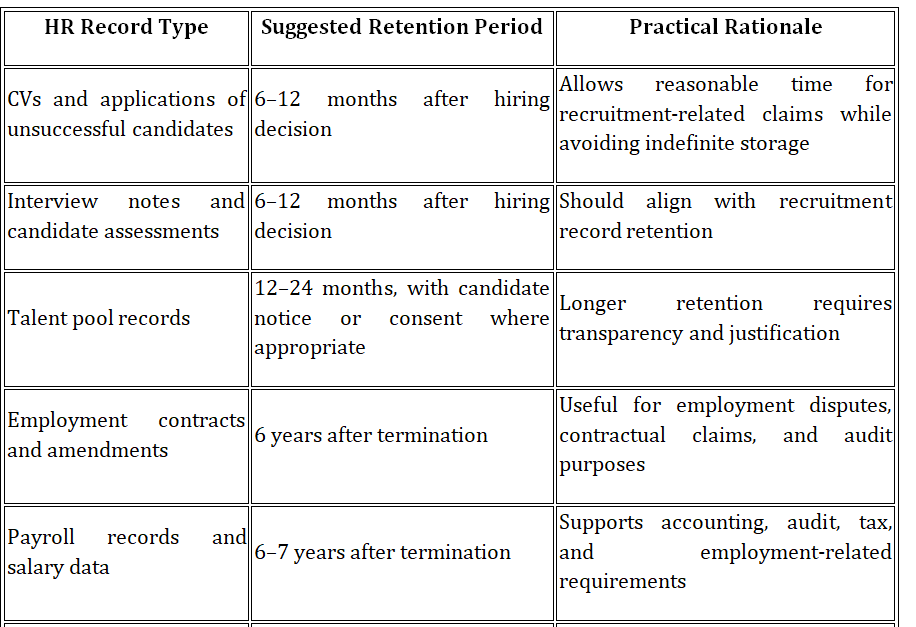
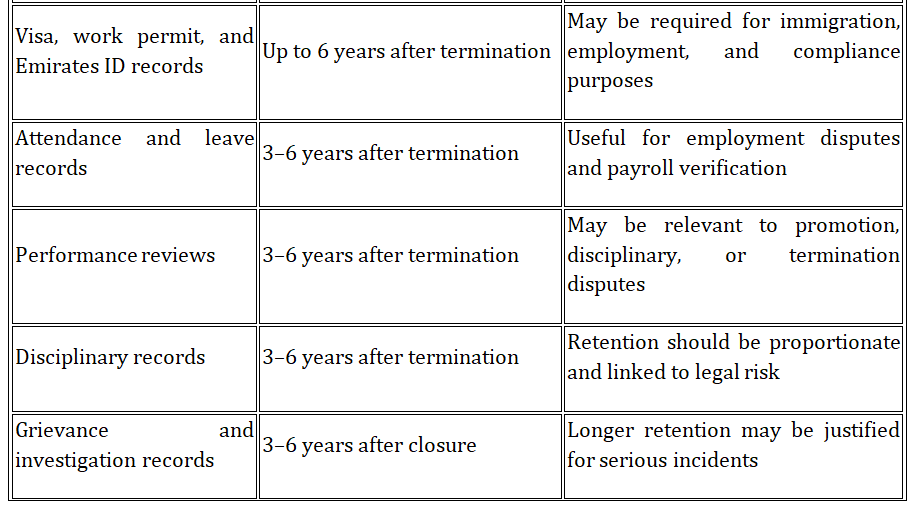
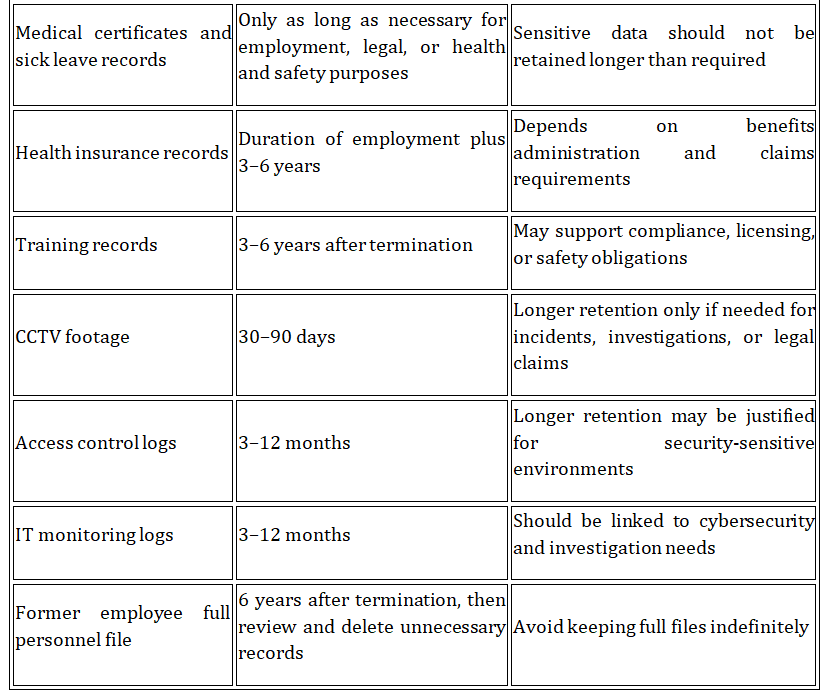
Recommended HR Retention Schedule
The table below provides indicative best-practice retention periods. These should be adapted to the company’s legal obligations, industry, jurisdiction, and risk profile.
Many UAE employers keep HR records for years without a clear reason. Employee files, CVs, passport copies, payroll records, medical certificates, CCTV footage, and disciplinary documents often remain stored in HR systems, shared drives, email folders, and paper archives long after they are needed.
From a data protection perspective, this creates unnecessary risk.
A well-designed HR Data Retention Schedule helps employers decide how long different categories of employee data should be kept, when they should be deleted, and who is responsible for managing the process.
For companies operating under the UAE PDPL, DIFC Data Protection Law, ADGM Data Protection Regulations, or international privacy standards such as the GDPR, retention management is not just an administrative task. It is a core part of privacy compliance.
What Is an HR Data Retention Schedule?
An HR Data Retention Schedule is a document that defines how long different types of HR records should be retained. It usually includes:
- Type of HR record;
- Purpose of retention;
- Legal or business justification;
- Retention period;
- Disposal method;
- Responsible department;
- Exceptions, such as litigation or investigations.
In simple terms, it answers one practical question: “How long do we actually need to keep this employee data?”
Why HR Data Retention Matters
HR departments process some of the most sensitive information in any organization. This may include:
- Passport copies;
- Emirates ID details;
- Visa documents;
- Salary records;
- Bank account details;
- Medical certificates;
- Performance reviews;
- Disciplinary records;
- CCTV footage;
- Access control logs.
Keeping this data longer than necessary increases the risk of:
- Data breaches;
- Unauthorized access;
- Employee complaints;
- Regulatory scrutiny;
- Internal misuse;
- Reputational damage.
A retention schedule reduces these risks by ensuring that personal data is not kept “just in case” forever.
The Key Privacy Principle: Do Not Keep Data Longer Than Necessary
Modern data protection laws are based on the principle of storage limitation.
This means that personal data should only be kept for as long as necessary for the purpose for which it was collected.
For UAE employers, this principle is highly relevant under the UAE Personal Data Protection Law (PDPL). Similar principles apply in DIFC, ADGM, the UK, the EU, and other mature privacy regimes.
The challenge is that privacy laws often do not provide a single fixed retention period for every HR document. This means employers must assess each record category and define a reasonable retention period based on legal, regulatory, contractual, and business needs.
Best Practices from Other Jurisdictions
International best practice usually follows a practical approach:
UK and EU Practice
UK and EU privacy guidance generally emphasizes that employers should:
- Identify why each HR record is retained;
- Avoid keeping excessive information;
- Define retention periods in advance;
- Delete or anonymize records when no longer needed;
- Be able to justify retention if challenged.
This approach is useful for UAE companies because the PDPL is aligned with many international privacy principles.
US Practice
In the United States, HR retention rules are often more prescriptive and vary by record type. Employers commonly retain payroll, employment, benefits, and recruitment records for different periods based on federal and state requirements.
The lesson for UAE employers is practical: do not apply one retention period to all HR data. Different records create different risks and serve different purposes.
Practical Best Practice for UAE Companies
For UAE employers, the strongest approach is to combine:
- UAE legal requirements;
- Employment limitation periods;
- Immigration and payroll obligations;
- International privacy principles;
- Business necessity;
- Security risk assessment.
This creates a defensible and practical retention framework.
Recommended HR Retention Schedule
The table below provides indicative best-practice retention periods. These should be adapted to the company’s legal obligations, industry, jurisdiction, and risk profile.
Real-World Case: “We Keep Everything Forever”
During an HR privacy review for a UAE-based company with around 150 employees, the HR department stated that all employee records were kept permanently.
The company had no retention schedule. Employee data was stored across:
The review identified several issues:
After the review, the company implemented:
The result was a significant reduction in privacy risk without affecting HR operations.
This type of issue is common. Many companies only discover it during an audit, due diligence process, employee complaint, or data breach investigation.
How to Build an HR Data Retention Schedule
Step 1: Map Your HR Data
Start by identifying where HR data exists. Common locations include:
Without HR data mapping, it is almost impossible to create a reliable retention schedule.
Step 2: Categorize the Records
Separate records into categories such as:
Each category should have its own retention period.
Step 3: Identify Legal and Business Reasons
For each record type, ask:
The stronger the justification, the easier it is to defend retention.
Step 4: Define Retention Periods
Avoid vague wording such as:
Instead, use clear retention periods, such as:
Step 5: Define Disposal Methods
A retention schedule should explain what happens after the retention period expires. Options include:
For paper records, secure shredding or certified destruction may be appropriate.
Step 6: Assign Responsibility
Retention fails when no one owns the process. Usually, responsibility is shared between:
A good schedule identifies who is responsible for each record category.
Common Mistakes Employers Make
Employers often create unnecessary privacy risks by:
These issues are usually easy to fix once they are identified.
Special Considerations for Sensitive HR Data
Some HR data requires extra caution. This includes:
For these categories, employers should apply stricter access controls, shorter retention periods, and additional justification. The more sensitive the data, the stronger the reason must be for keeping it.
What About Legal Holds?
A retention schedule should include exceptions.
If there is an ongoing dispute, investigation, litigation, regulatory inquiry, or employee complaint, relevant records should not be deleted merely because the standard retention period has expired.
Instead, the organization should apply a legal hold. A legal hold should be:
This prevents accidental deletion of important evidence while avoiding unnecessary retention of unrelated data.
HR Data Retention Checklist
Before finalizing an HR Retention Schedule, employers should confirm:
✓ HR data has been mapped
✓ Record categories are clearly defined
✓ Retention periods are documented
✓ Legal and business justifications are recorded
✓ Sensitive data receives additional controls
✓ CCTV and monitoring data have short retention periods
✓ Former employee files are reviewed after termination
✓ Candidate data is not kept indefinitely
✓ Deletion responsibilities are assigned
✓ Legal hold procedures are included
✓ Employee Privacy Notice reflects retention practices
Conclusion
An HR Data Retention Schedule is one of the most practical tools for improving privacy compliance and reducing risk.
For UAE employers, the goal is not to delete everything immediately or keep everything forever. The goal is to retain each category of HR data only for as long as there is a clear legal, regulatory, contractual, or business reason.
By combining UAE legal requirements with international best practices, employers can build a defensible retention framework that supports PDPL compliance, improves HR governance, and reduces the risk of data breaches, employee complaints, and regulatory scrutiny.
During an HR privacy review for a UAE-based company with around 150 employees, the HR department stated that all employee records were kept permanently.
The company had no retention schedule. Employee data was stored across:
- HR software;
- Payroll folders;
- Shared drives;
- Email attachments;
- Physical personnel files;
- Archived recruitment folders.
The review identified several issues:
- CVs of unsuccessful candidates were kept for more than five years;
- Former employee passport copies were stored indefinitely;
- Medical certificates were accessible to non-HR staff;
- CCTV footage was retained for more than one year;
- No documented deletion process existed;
- No one was responsible for retention management.
After the review, the company implemented:
- An HR Data Retention Schedule;
- A 12-month retention period for unsuccessful candidates;
- A 60-day CCTV retention rule;
- Role-based access controls for medical and payroll records;
- Annual HR data deletion review;
- Secure destruction procedure for paper files;
- Employee Privacy Notice updates.
The result was a significant reduction in privacy risk without affecting HR operations.
This type of issue is common. Many companies only discover it during an audit, due diligence process, employee complaint, or data breach investigation.
How to Build an HR Data Retention Schedule
Step 1: Map Your HR Data
Start by identifying where HR data exists. Common locations include:
- HR systems;
- Payroll platforms;
- Recruitment tools;
- Email inboxes;
- Shared drives;
- Cloud folders;
- Paper archives;
- CCTV systems;
- Access control systems.
Without HR data mapping, it is almost impossible to create a reliable retention schedule.
Step 2: Categorize the Records
Separate records into categories such as:
- Recruitment;
- Employment;
- Payroll;
- Immigration;
- Benefits;
- Performance;
- Disciplinary;
- Health and safety;
- Monitoring and security.
Each category should have its own retention period.
Step 3: Identify Legal and Business Reasons
For each record type, ask:
- Is there a legal requirement to keep it?
- Could it be needed for employment claims?
- Is it required for tax or accounting purposes?
- Is it necessary for immigration compliance?
- Is it needed for operational continuity?
- Is it sensitive or high-risk?
The stronger the justification, the easier it is to defend retention.
Step 4: Define Retention Periods
Avoid vague wording such as:
- “Keep as needed”
- “Retain permanently”
- “Archive indefinitely”
Instead, use clear retention periods, such as:
- 6 months after recruitment decision;
- 6 years after employment termination;
- 60 days after CCTV recording;
- Until claim is resolved.
Step 5: Define Disposal Methods
A retention schedule should explain what happens after the retention period expires. Options include:
- Secure deletion;
- Anonymization;
- Physical destruction;
- Restricted legal hold;
- Archive review.
For paper records, secure shredding or certified destruction may be appropriate.
Step 6: Assign Responsibility
Retention fails when no one owns the process. Usually, responsibility is shared between:
- HR;
- Legal;
- Compliance;
- IT;
- Information Security.
A good schedule identifies who is responsible for each record category.
Common Mistakes Employers Make
Employers often create unnecessary privacy risks by:
- Keeping HR files indefinitely;
- Applying one retention period to all records;
- Forgetting recruitment data;
- Retaining CCTV footage for too long;
- Keeping duplicate passport copies;
- Storing medical records with general HR files;
- Failing to delete email attachments;
- Not documenting legal holds;
- Having no deletion process.
These issues are usually easy to fix once they are identified.
Special Considerations for Sensitive HR Data
Some HR data requires extra caution. This includes:
- Medical information;
- Biometric data;
- Criminal background checks;
- Disciplinary records;
- CCTV footage;
- Employee monitoring logs.
For these categories, employers should apply stricter access controls, shorter retention periods, and additional justification. The more sensitive the data, the stronger the reason must be for keeping it.
What About Legal Holds?
A retention schedule should include exceptions.
If there is an ongoing dispute, investigation, litigation, regulatory inquiry, or employee complaint, relevant records should not be deleted merely because the standard retention period has expired.
Instead, the organization should apply a legal hold. A legal hold should be:
- Documented;
- Limited to relevant records;
- Reviewed periodically;
- Lifted once the matter is resolved.
This prevents accidental deletion of important evidence while avoiding unnecessary retention of unrelated data.
HR Data Retention Checklist
Before finalizing an HR Retention Schedule, employers should confirm:
✓ HR data has been mapped
✓ Record categories are clearly defined
✓ Retention periods are documented
✓ Legal and business justifications are recorded
✓ Sensitive data receives additional controls
✓ CCTV and monitoring data have short retention periods
✓ Former employee files are reviewed after termination
✓ Candidate data is not kept indefinitely
✓ Deletion responsibilities are assigned
✓ Legal hold procedures are included
✓ Employee Privacy Notice reflects retention practices
Conclusion
An HR Data Retention Schedule is one of the most practical tools for improving privacy compliance and reducing risk.
For UAE employers, the goal is not to delete everything immediately or keep everything forever. The goal is to retain each category of HR data only for as long as there is a clear legal, regulatory, contractual, or business reason.
By combining UAE legal requirements with international best practices, employers can build a defensible retention framework that supports PDPL compliance, improves HR governance, and reduces the risk of data breaches, employee complaints, and regulatory scrutiny.
